

The purpose of nose augmentation surgery is to correct nasal defects to make the face more harmonious, or even to… improve feng shui. However, this method also has certain limitations that you need to consider before deciding to undergo the procedure.
What is nose augmentation surgery?
Nose augmentation surgery is probably very familiar to us, especially women. This is a method of reshaping the nose, which may or may not intervene in the anatomical structure of the nose to change the height, curvature, and shape of the nose. After surgery, the nose will become harmonious and balanced with the face.
Nose augmentation surgery is indicated in many different cases, most commonly the following:
- Low, flat nose, wide nostrils, and a nose bridge that appears to be absent.
- High nose but with a hump, crookedness, or misalignment.
- Congenital nasal deformity.
- Nasal trauma.
- Nasal problems causing health issues, such as difficulty breathing or suffocation.

Rhinoplasty Procedure
The rhinoplasty procedure differs between simple rhinoplasty and structural rhinoplasty.
Simple Rhinoplasty
This surgical method is suitable for noses without too many defects. The surgery is also simple and does not take much time because the doctor only makes an incision under the skin and nasal periosteum and then inserts a cartilage framework to shape the nasal bridge.
Currently, the cartilage framework for shaping the nasal bridge is made from many materials, including synthetic and autologous materials. To achieve the best results, doctors often combine both materials, specifically silicone with ear cartilage.
The advantage of simple rhinoplasty is that it doesn’t significantly alter the anatomical structure of the nose, thus reducing the risk of deformity. However, the limitation is that it’s only suitable for noses without many defects.
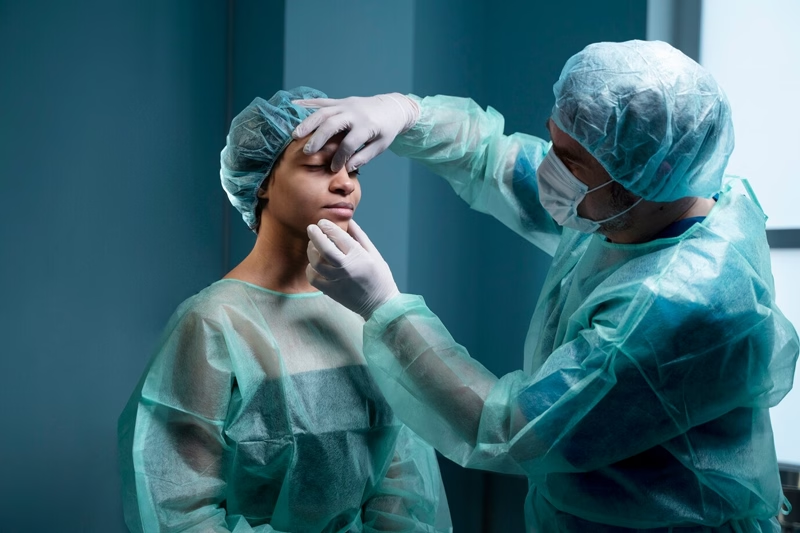
Structural Rhinoplasty
This surgical method is suitable for noses with many defects due to congenital factors or trauma. The procedure is time-consuming and may require multiple surgeries to change the structure of the nasal tip and raise the nasal bridge, specifically as follows:
- Autologous cartilage is harvested, which can be from the nasal septum, ear cartilage, or rib cartilage.
- The nasal tip structure is altered by exposing the nasal tip, accessing the nasal septum and alar cartilage. Next, the harvested autologous cartilage is inserted to create a new nasal tip cartilage framework.
- The nasal bridge is raised.
The advantage of structural rhinoplasty is that it completely corrects nasal defects, giving the nose a completely new appearance. In addition, it can also improve some health problems caused by the nose. However, the disadvantages are the long procedure time, high cost, and the potential for complications such as deformity, especially when performed at unreliable facilities.
Precautions Before and After Rhinoplasty
To ensure your health and avoid complications during and after rhinoplasty, you need to follow these guidelines.
Before Rhinoplasty
You will undergo a health check and important tests. This is the basis for the doctor to assess and decide whether you are eligible for surgery. At the same time, during the examination, the doctor will advise you on the most suitable rhinoplasty method.
Suitable here means suitable for your nasal characteristics as well as your wishes and conditions. Therefore, don’t hesitate to discuss with your doctor to get the best possible advice.
For one week before surgery, avoid alcohol, tobacco, and stimulants. Additionally, anti-inflammatory drugs or herbal remedies should be limited or carefully considered to avoid affecting bleeding during and after surgery.
The night before surgery, avoid eating and drinking, maintain good personal hygiene, and go to bed early to ensure the best preparation for the rhinoplasty surgery the following morning.

After rhinoplasty surgery
For the first week after surgery, you must always wear a nasal splint as instructed. This helps to stabilize the nose shape and prevent accidental impacts that could affect the shape and increase the risk of infection at the surgical site.
Bruising or swelling in or around the nose is normal. To reduce discomfort, you can apply cold compresses or take medication prescribed by your doctor. The condition will improve after 2-3 days.
After 1 week of surgery, the nasal splint can be removed, and bruising and swelling will significantly improve. However, the nose is not yet fully recovered and is still in the “shaping” phase. Therefore, you should be cautious in your daily activities, avoiding strenuous exercise or movement, especially bending or stretching postures.
After 2-3 weeks, you can basically resume normal activities, and your nose will look more natural. After 6 months, the nose will be completely healed, and the shape will be more defined; it will be difficult to tell that you’ve just had rhinoplasty.

Especially, attend your follow-up appointments as scheduled by your doctor to ensure the incision heals well and the nose has taken the desired shape. You absolutely must not skip these follow-up appointments because rhinoplasty, like other surgeries, can cause complications such as bleeding and infection. More seriously, this surgery carries other risks such as nosebleeds, difficulty breathing, abnormal nose shape, scarring on the nose, perforation of the nasal tip, etc.